
Choosing the right warehouse rack can make a huge difference in how smoothly your operations run. You want a system that fits your space, handles your products efficiently, and saves you time and money.
But with options like Selective, Drive-In, and Push-Back racks, which one is truly the best for you? This article will guide you through the pros and cons of each type, helping you find the perfect match for your warehouse needs.
Keep reading to discover which rack system can boost your storage and streamline your workflow.
Selective Racking Basics
Selective racking is one of the most common storage systems in warehouses. It provides direct access to every pallet stored. This makes it easy to organize and manage inventory. Many businesses use selective racks because they are simple and flexible.
These racks consist of rows with beams and uprights. Pallets sit on the beams, creating multiple levels of storage. This setup allows forklifts to pick or place pallets quickly. It suits many different types of products and industries.
Key Features
Selective racks offer full access to each pallet. The design includes upright frames and horizontal beams. Pallets sit on these beams in rows and columns. The racks can be adjusted to fit different pallet sizes. They allow for easy loading and unloading by forklifts. The system supports both single and double deep storage. It is simple to install and modify.
Ideal Applications
Selective racking works well for warehouses with many product types. It fits warehouses needing easy access to all items. Perfect for businesses with fast-moving goods. It suits operations that use first-in, first-out inventory management. Good choice for small to medium-sized warehouses. It handles a variety of pallet sizes and weights.
Advantages And Limitations
Selective racks provide excellent inventory visibility. They allow quick access to any pallet. Easy to install and flexible for changes. They support a wide range of products. Space use is less efficient compared to other systems. Not ideal for very high-density storage needs. Requires more aisle space for forklift movement. Best for warehouses prioritizing access over maximum storage.
Drive-in Racking Essentials
Drive-in racking is a popular storage system designed for high-density storage. It allows forklifts to drive directly into the rack’s bays. This design maximizes warehouse space by reducing the number of aisles needed. It works well for storing large amounts of similar products.
Understanding the essentials of drive-in racking helps you decide if it fits your warehouse needs. The system has unique features and specific uses. It also has benefits and some limitations to consider.
Core Characteristics
Drive-in racks are deep storage racks with no aisles between storage lanes. Forklifts enter the rack to place or retrieve pallets. Pallets are stored several positions deep, usually four to six levels high. This system uses a last-in, first-out (LIFO) inventory method. Rails support the pallets and guide forklift entry and exit.
Best Use Cases
Drive-in racking suits warehouses storing large amounts of the same product. It works well for items that don’t need frequent rotation. Cold storage and frozen food warehouses use this system often. It fits businesses with limited floor space but high storage needs. Ideal for bulk storage and seasonal products.
Benefits And Drawbacks
Drive-in racking saves floor space by reducing aisle width. It increases storage density significantly. The system lowers material handling time for similar products. It also cuts down on storage costs per pallet.
Drawbacks include limited product accessibility. Only the last pallet loaded can be accessed first. This makes it less flexible for mixed product storage. Damage risk is higher due to forklift entry inside the rack. It requires skilled forklift operators to avoid accidents.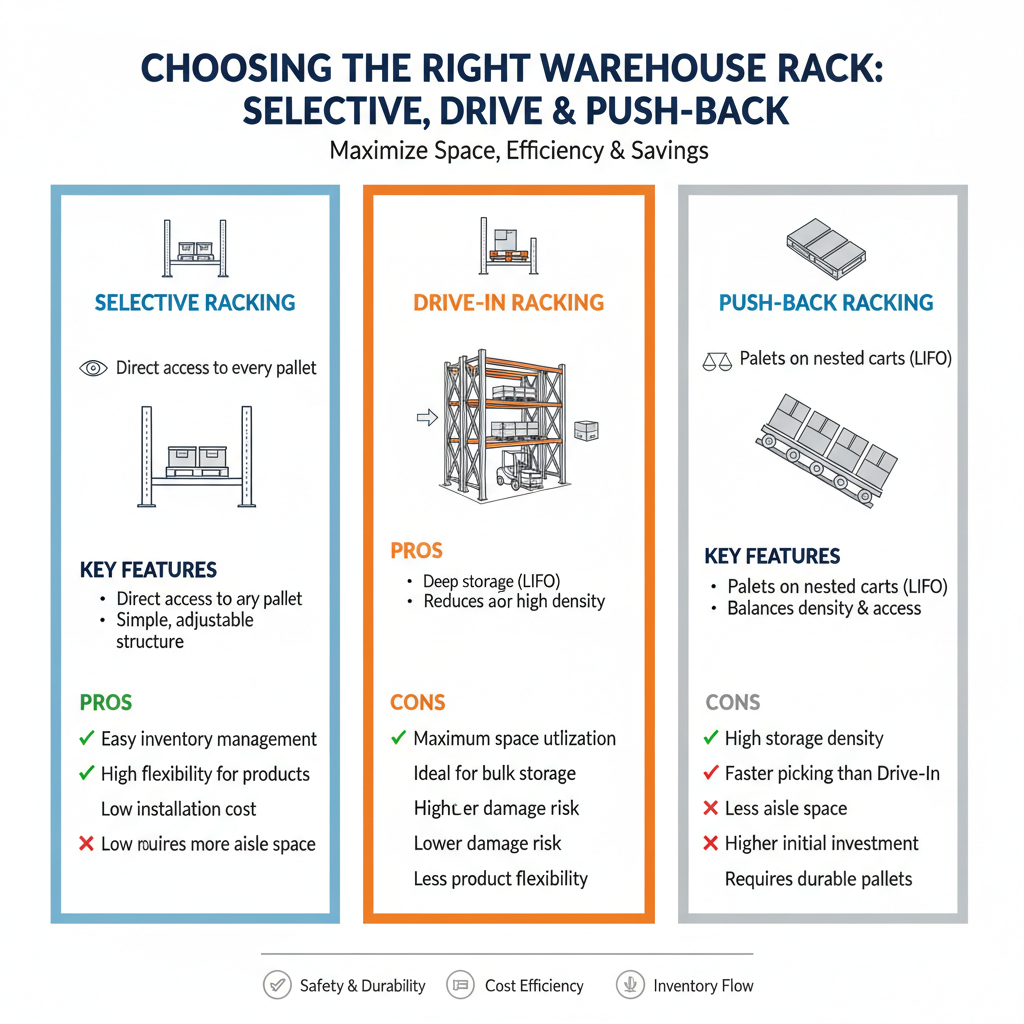
Push-back Racking Insights
Push-back racking is a popular choice for warehouses needing high storage density. It uses a unique system that stores pallets on a series of carts. This design allows for multiple pallets deep storage, reducing aisle space.
It offers more storage in less space compared to selective racking. Understanding how push-back racking works can help decide if it fits your warehouse needs.
How It Works
Push-back racking stores pallets on nested carts inside the rack. When you load a pallet, it pushes the carts backward. The next pallet slides into the space left behind. When you unload, the carts roll forward, bringing the next pallet to the front.
This system works on a last-in, first-out (LIFO) basis. It allows quick access to the most recent pallet loaded.
Suitable Environments
Push-back racking suits warehouses with medium to high inventory turnover. It fits well where space is limited but access to multiple pallets is needed. Ideal for products that do not require strict FIFO rotation. Warehouses handling similar products in bulk benefit the most.
Pros And Cons
Push-back racking saves aisle space and increases storage density. It reduces forklift travel time and improves picking speed. The system is safer than some other high-density racks.
On the downside, it does not allow direct access to every pallet. It works best with products that can be rotated in LIFO order. The initial investment can be higher than selective racking.
Comparing Storage Capacity
Comparing storage capacity helps you choose the right warehouse rack for your needs. Each type offers different ways to store goods efficiently. Understanding space use, load handling, and accessibility is key. This section breaks down these factors to help you decide.
Space Utilization
Selective racks use more aisle space but offer easy access. Drive-in racks save aisle space by stacking pallets deep. Push-back racks fit more pallets by using a sliding system. Drive-in and push-back racks maximize cubic space better than selective racks.
Load Handling
Selective racks handle various pallet sizes and weights easily. Drive-in racks require uniform pallets for safe stacking. Push-back racks support heavy loads with strong rollers and tracks. Each system suits different load types and warehouse needs.
Accessibility
Selective racks provide direct access to every pallet quickly. Drive-in racks limit access to the front pallet only. Push-back racks allow access to the front pallet and slide others back. Selective racks offer the best accessibility for fast picking.
Cost Considerations
Cost plays a big role in choosing the right warehouse rack. Different rack types come with different price tags. You must think about upfront costs and future expenses. This helps you pick a rack that fits your budget and needs.
Initial Investment
Selective racks usually cost less to buy and install. They are simple in design and easy to set up. Drive-in racks need more steel and space, so they cost more upfront. Push-back racks fall between the two in price. The cost depends on the number of levels and the rack size.
Maintenance Expenses
Selective racks require less maintenance because of their open design. Drive-in racks have more moving parts, so repairs can cost more. Push-back racks also have moving parts that need regular checks. Keeping racks in good shape avoids costly repairs later.
Long-term Value
Selecting a rack with good long-term value saves money over time. Drive-in racks offer high storage density, which can reduce warehouse costs. Push-back racks improve space use and keep products accessible. Think about how the rack will work with your business growth.
Safety And Durability
Safety and durability are key factors when choosing warehouse racks. These racks must hold heavy loads without bending or breaking. They need to protect workers and goods. Understanding their strength and risks helps you pick the best option.
Structural Strength
Selective racks have strong beams and uprights. They support heavy pallets and allow easy access. Drive-in racks use thick steel and solid frames. They handle deep stacking but need careful design. Push-back racks combine strong carts and racks. They offer good weight support with sliding carts.
Risk Factors
Selective racks have less risk of damage. Each pallet is easy to reach without moving others. Drive-in racks carry more risk. Forklifts must be careful inside narrow aisles. Push-back racks have moving parts. These parts may need regular checks to avoid failure.
Compliance Standards
All racks must meet safety codes. These include weight limits and fire safety rules. Selective racks often meet most standards easily. Drive-in and push-back racks require special checks. Make sure your racks follow local warehouse laws. Proper installation and inspection keep workers safe.
Choosing Based On Inventory Type
Choosing the right warehouse rack depends heavily on the type of inventory you manage. Different racks serve different storage needs, making it important to match the rack to your inventory. Understanding your products helps you pick the most efficient system. This section breaks down the choice by product variety, turnover rate, and storage duration.
Product Variety
Racks must fit the variety of products stored. Selective racks work well with many product types. They provide easy access to each item. Drive-in racks suit fewer product types but larger quantities. Push-back racks store similar items in layers. This makes them ideal for grouped products. Choose a rack that handles your product mix best.
Turnover Rate
Turnover rate affects rack choice. High turnover means fast access is vital. Selective racks offer quick pick-up and restock. Low turnover items can use drive-in or push-back racks. These racks maximize storage space but slow access. Match rack type to how fast products move.
Storage Duration
Storage duration shapes rack needs. Short storage times call for easy access racks. Selective racks work well here. For long-term storage, drive-in and push-back racks save space. These racks store many pallets deep. They reduce aisle space but limit quick access.
Installation And Space Requirements
Choosing the right warehouse rack depends a lot on installation and space needs. Each rack type uses space differently and requires unique setup steps. Understanding these factors helps pick a system that fits your warehouse size and layout perfectly.
Layout Impact
Selective racks work well in many layouts. They need clear aisles for easy access to items. Drive-in racks save aisle space by using fewer aisles. This setup stacks goods deep but limits direct access to all pallets. Push-back racks use a sloped design to store pallets behind one another. They need less aisle space than selective racks but more than drive-in racks.
Installation Complexity
Selective racks are the easiest to install. Their simple design means fewer parts and faster setup. Drive-in racks require careful alignment and strong support for safety. Installation takes more time and skill. Push-back racks have moving parts like carts or rollers. Installing these takes expert help and more time than selective racks.
Scalability
Selective racks are highly scalable. You can add sections as your storage grows. Drive-in racks are harder to expand because of their fixed aisle setup. Push-back racks offer moderate scalability. Expanding requires matching the slope and mechanics of existing racks. Plan space and installation needs ahead for smooth growth.
Technology Integration
Technology plays a big role in choosing the right warehouse rack. It affects how well the racks work with modern systems. It also impacts the speed and accuracy of warehouse tasks. Understanding technology integration can help you make a smart choice for your warehouse.
Automation Compatibility
Some racks work better with robots and automated machines. Selective racks are often easy to use with automation. Drive-in racks may need special adjustments for machines. Push-back racks offer good access but can limit robot movement. Choose racks that fit your current and planned automation tools.
Warehouse Management Systems
Warehouse management systems (WMS) track inventory and organize tasks. Certain racks pair well with WMS software. Selective racks allow easy scanning and tracking of goods. Drive-in and push-back racks require more system planning for accuracy. Integrating racks with WMS boosts warehouse efficiency and reduces errors.
Future-proofing
Technology changes fast. Select racks that adapt to future needs. Selective racks offer flexibility for new tech and layouts. Drive-in racks may limit changes due to design. Push-back racks fall between selective and drive-in for upgrades. Plan for growth and new technology when choosing racks.
Case Studies And Real-world Examples
Understanding different warehouse racking systems can be easier through real examples. Case studies show how Selective, Drive-In, and Push-Back racks work in real settings. These stories reveal which rack suits specific needs. They help businesses decide based on facts, not just theory.
Industry-specific Solutions
Food and beverage companies often use Drive-In racks. They store many pallets in a smaller space. This system helps keep products fresh by using a first-in, last-out method. Electronics warehouses prefer Selective racks. It allows quick access to many different items. Push-Back racks work well in retail distribution centers. They balance storage density with easy pallet access.
Success Stories
A furniture company switched from Selective to Push-Back racks. Their storage capacity increased by 30%. They saved time during loading and unloading. A beverage distributor used Drive-In racks to fit more pallets. This change reduced warehouse space needs by 25%. Another business improved order picking speed with Selective racks. It helped meet tighter delivery schedules.
Lessons Learned
Not every rack fits all warehouses. Drive-In racks need careful planning to avoid damage. Push-Back racks require strong pallets to prevent accidents. Selective racks offer flexibility but need more space. Businesses must consider product type, turnover rate, and space. Testing small setups first can avoid costly mistakes.

- The Fortnite Flowering Chaos bundle comes with 8 PlayStation exclusive cosmetics (estimated value of 5,000 V-Bucks) plus…
- Florin Outfit (with LEGO Style)
- Blossom Backpack Back Bling
Frequently Asked Questions
What Is The Main Difference Between Selective And Drive-in Racks?
Selective racks provide easy access to all pallets individually. Drive-in racks maximize storage by stacking pallets deep but limit access to last-in-first-out inventory.
Which Rack Type Offers The Highest Storage Density?
Drive-in and push-back racks offer higher storage density than selective racks. They use deep lane storage but trade off direct pallet access.
Are Push-back Racks Suitable For Fast Inventory Turnover?
Push-back racks allow last-in-first-out access and moderate picking speed. They balance storage density and accessibility, ideal for medium turnover rates.
How Does Warehouse Layout Affect Rack System Choice?
Warehouse size, aisle width, and forklift type impact rack selection. Selective racks suit narrow aisles, while drive-in racks need wider lanes for access.
Conclusion
Choosing the right warehouse rack depends on your storage needs. Selective racks offer easy access to all items. Drive-in racks save space but limit access to some products. Push-back racks increase storage density with quicker retrieval than drive-in. Think about your inventory size, turnover, and budget.
Each type has its strengths and fits different situations. Decide what matters most: space, access, or cost. The right rack helps your warehouse run smoothly. Make a smart choice for your business today.

- The Original and Authentic Version of the Sensational Party Game
- Get ready for the award-winning fast-paced word game that gives family game night a rush of excitement as players compet…
- HOW TO PLAY – Choose a card with a category, press the timer, and shout out words related to the category that start wit…

- Skins! We have biome settlers, city folk, town folk, and more!
- The Nether and all its inhabitants. Fight Ghasts and make friends with Pigmen
- Cross platform play for up to five players between Pocket Edition and Windows 10

- Play it Safe or Risk it All? – In Flip7, you will press your luck by getting dealt cards without revealing the same numb…
- How to Win – Be the first to reach 200 points in this intense press-your-luck game that tests your risk-taking and strat…
- Beware of Busting – Rack up points based on the total number value of the cards in front of you but watch out for duplic…

- RULE THE GRID 4 THE WIN: With this classic Connect 4 game, featuring a sleek modern style, players go head-to-head as th…
- EXCITING STRATEGY GAME: Challenge a friend to rule the grid! Strategy drives the competition in this Connect 4 board gam…
- MODERN STYLE & COOL COLORS: The Connect 4 Classic Grid kids game takes the popular game one step further with a sleek st…

- VIBRANT COLOR GAME: Challenge friends and family to connect words with colors in the engaging Hues and Cues, featuring 4…
- FUN FOR ALL AGES: Perfect for family game nights, parties, or casual play, this game brings players of all ages together…
- UNIQUE EXPERIENCE: No two rounds are the same! Hues and Cues provides a new and unique experience with each playthrough,…

- INTRODUCING A DIGITAL DIE: More suspense, more surprises, more laughs! In this Jenga game, enjoy the classic Jenga gamep…
- 6 MORE WAYS TO PLAY: Roll the digital die for unpredictable challenges: play using thumbs only, race against the clock, …
- HILARIOUS CHALLENGES: Actions like “Team-Up” amp up the fun! A player who rolls it selects another player to act as thei…

- UNO card game provides classic play, where players match colors or numbers in a race to get rid of all their cards!
- Action Cards and Wild Cards add unexpected excitement and game-changing fun, like the Reverse Card that switches the dir…
- The deck includes 3 blank Wild Cards for house rules anyone can make up — erase and create new rules each game!