
As an Amazon Associate, RackReveal earns from qualifying purchases. Some links on this page are affiliate links, at no extra cost to you.
Roof rack tie downs only work if they are the right kind, wrapped around the right part of the rack, and pulled to the right tension. This guide covers which straps to use, how to tie down a general load and a kayak or board step by step, and the mistakes that let loads shift. If you need straps, we’ve added four cam buckle tie downs that were in stock on Amazon US when we checked; the details come from each listing, and we haven’t tested them hands-on.
Quick answer: use at least two non-stretch cam straps, loop each one under a crossbar (not just over it), pull it snug, put a twist in any strap section that flaps in the wind, tie off the loose ends, and check the load again after a short drive. Skip bungee cords for the main load, and add bow and stern lines for long loads like kayaks.
Which Roof Rack Tie Down to Use
| Tie down | Use it for | Watch out for |
|---|---|---|
| Cam buckle strap | Most roof loads: bags, boxes, kayaks, surfboards, lumber | Tightened by hand, so you can’t easily over-crank it; still check tension |
| Ratchet strap | Hard, heavy cargo that won’t crush | Easy to over-tighten and crush the load or stress the rack |
| Bow and stern lines | Long loads such as kayaks and canoes, as an extra layer | Need secure anchor points on the vehicle; follow your rack or vehicle guidance |
| Bungee cord | Light extras only, on a load that is already strapped | Stretches, so the load can move and work loose |
Strapping cargo in a pickup bed instead? See our guide to tie down straps for truck beds.
Before You Load
- Check the weight limit. Your vehicle’s roof, your rack and any basket or box each have their own load limit, so follow each maker’s driving-load limit and how it defines it. Add up the rack, any accessories and the cargo for the total on the roof.
- Check the rack. Make sure the towers and crossbars are tight and the rack is fitted to your vehicle as its instructions say. Our roof rack and crossbar guide explains the parts.
- Place the load. Center it between the crossbars, side to side and front to back, with the heaviest items at the bottom, and keep it within the area your rack instructions allow.
- Check the straps. Don’t use straps with cuts, fraying, sun damage or a buckle that slips.
How to Tie Down a Load on a Roof Rack, Step by Step
This method suits a firm load that is properly supported, such as a roof bag or box in a basket or on a platform, or a tied bundle resting across both crossbars. Tie loose pieces in a bundle together first so none can slide out.
- Use two straps or more. Plan one strap at each crossbar, or one at each end of a basket.
- Loop around the bar. Pass the strap under and around the crossbar (or through a tie-down point on the rack or basket), not just over it, so it is anchored to the rack. Position the straps as your rack instructions say. Never anchor to plastic trim, door seals or anything not built to hold the load.
- Go over the load. Bring the strap up and over the load, then under the bar on the other side and back up to the buckle. Keep the buckle on top of or beside the load, not on the roof paint.
- Keep it flat on the load. Don’t let the strap twist where it presses on the load, so it bears evenly.
- Pull it snug. Thread the free end through the cam buckle the way its instructions show, pull it until the load can’t shift, then let go of the cam and pull back on the strap to check it locks. Don’t stand on it or crank it further.
- Stop the strum. Anywhere a section of strap is in open air and not lying against the load or rack, put a twist in it.
- Tie off the excess. Tie the loose tail off to the rack or the strap itself (or use a secure strap keeper) so it can’t flap, whip the paint or work the buckle loose. Don’t just tuck it, and don’t shut it in a door.
- Test it. Push and pull on the load in every direction, including sideways along the bars. It should move with the car, not on its own. Then stop after a short distance and check again.
How to Tie Down a Kayak or Surfboard
NRS’s guide to strapping kayaks recommends two straps, one on each crossbar, as a safety margin, because even one strap routed around both bars is still a single point of failure. For each strap: pass the buckle end under the crossbar, bring both ends up over the boat with the buckle on top, pass the free end down and under the crossbar, then bring it back up to the buckle and tighten. NRS adds a few tips:
- Don’t over-tighten. Snug enough to stop the boat shifting is enough; cranking down can crack composite hulls, distort plastic boats and over-stress the rack.
- Add bow and stern lines for extra security: they anchor the ends of the boat to the vehicle and counter lift in crosswinds and when passing trucks. Attach them only to secure points on the boat (grab loops or carry handles) and on the vehicle (such as the tie-down or tow points your vehicle or rack maker approves), pull them snug without bending the boat, and tie off the tails clear of the wheels.
- Protect the car from the buckle. A buckle that gets away from you while you throw a strap over can dent the car or break glass; buckle bumpers help.
- Don’t store boats on the roof. Leaving them strapped down for days or weeks can warp plastic hulls and adds UV exposure.
Surfboards: use padded bars or a surf rack, and follow your rack and board instructions for which way the board faces and how the straps are routed. See our surf rack straps guide.
Mistakes to Avoid
- Using bungee cords as the main tie down.
- Laying a strap over the crossbar instead of looping it under.
- Using only one strap on a substantial load.
- Over-tightening with a ratchet until the load or rack deforms.
- Leaving long strap tails or a flat strap humming in the wind.
- Going over your roof, rack or accessory load limit.
- Never rechecking the load on a long drive.
Rack itself noisy at speed? See how to reduce roof rack wind noise.
4 Roof Rack Tie Down Straps to Consider
| Strap | Width | Length | Notes (per listing) |
|---|---|---|---|
| Thule Load Straps | Not listed | 15 ft or 9 ft (pair) | Steel cam buckles with protective buckle bumpers; UV-resistant nylon |
| NRS 1.5″ Heavy Duty Straps | 1.5 in | 20 ft (pair) | 2,000 lb minimum breaking strength; webbing won’t stretch when wet |
| DAKINE Tie Down Straps | Not listed | 12 ft | Heavy-duty 1 in cam buckle; storage bag |
| Bison Gear Premium Tie Down Straps | 1 in | 16 ft (4 pack) | 600 lb break strength, 300 lb working load |
As listed on Amazon at the time of writing. Listings change, so check the product page before you buy. Breaking strength is not a working load limit or a roof capacity: never load a strap anywhere near its breaking strength, and the NRS listing doesn’t give a working load limit.
Thule Load Straps for Roof Mount Racks
Thule’s own roof rack straps. The listing says each strap has a steel cam-action buckle with a protective buckle bumper that fits over the buckle to protect the vehicle and load, uses UV-resistant heavy-duty nylon webbing, and comes as a pair in 15 ft or 9 ft lengths.
Best for: general roof loads and boats, with a bumper to protect your paint. Skip it if: you need more than two straps from one buy.

- Each strap features steel cam-action buckles and protective Buckle Bumpers that fit snugly over buckles to protect vehic…
- Heavy-duty nylon webbing is UV resistant
- Packaged as a pair in 15′ or 9′ lengths.
NRS 1.5″ Heavy Duty Straps (20 ft Pair)
Wide, long straps from a paddling brand. The listing gives a 2,000 lb minimum breaking strength, UV-protected polypropylene webbing that won’t stretch when wet, and a cam buckle with two stainless-steel springs.
Best for: bulky loads, wide boats and wet conditions where you want long straps. Skip it if: you want short straps with less tail to tie off.

- The NRS 1.5″ Strap delivers an extraordinary 2,000 lb. Minimum Breaking Strength (MBS) to take the worry out of any tie-…
- We build NRS Straps with UV-protected polypropylene webbing that won’t stretch when wet.
- Our time-tested cam buckle features two strong stainless-steel springs for a burly bite that won’t ever slip.
DAKINE Tie Down Straps (12 ft)
A surf and snow brand’s tie downs. The listing says they have a heavy-duty 1 in (25 mm) cam buckle and polypropylene webbing, come with a storage bag and integrate with Dakine board bags.
Best for: surfboards, snowboards and board bags on a padded rack. Skip it if: you need straps longer than 12 ft for a wide load.

- Dakine Tie Down Straps
- Heavy duty 1 in. (25 mm) cam buckle
- Integrates with Dakine surf/ski/snowboard travel boardbags
Bison Gear Premium Tie Down Straps (4 x 16 ft)
A four-pack of 16 ft cam buckle straps. The listing says they use 1 in polyester webbing with rustproof metal alloy cam buckles, gives a 600 lb break strength and 300 lb working load, and includes a storage bag.
Best for: enough straps for two loads, or a load plus spares. Skip it if: you want a buckle cover to protect your paint.

- LIFETIME WARRANTY – In the unlikely event that one of our straps fail we will replace it, regardless of the age. We call…
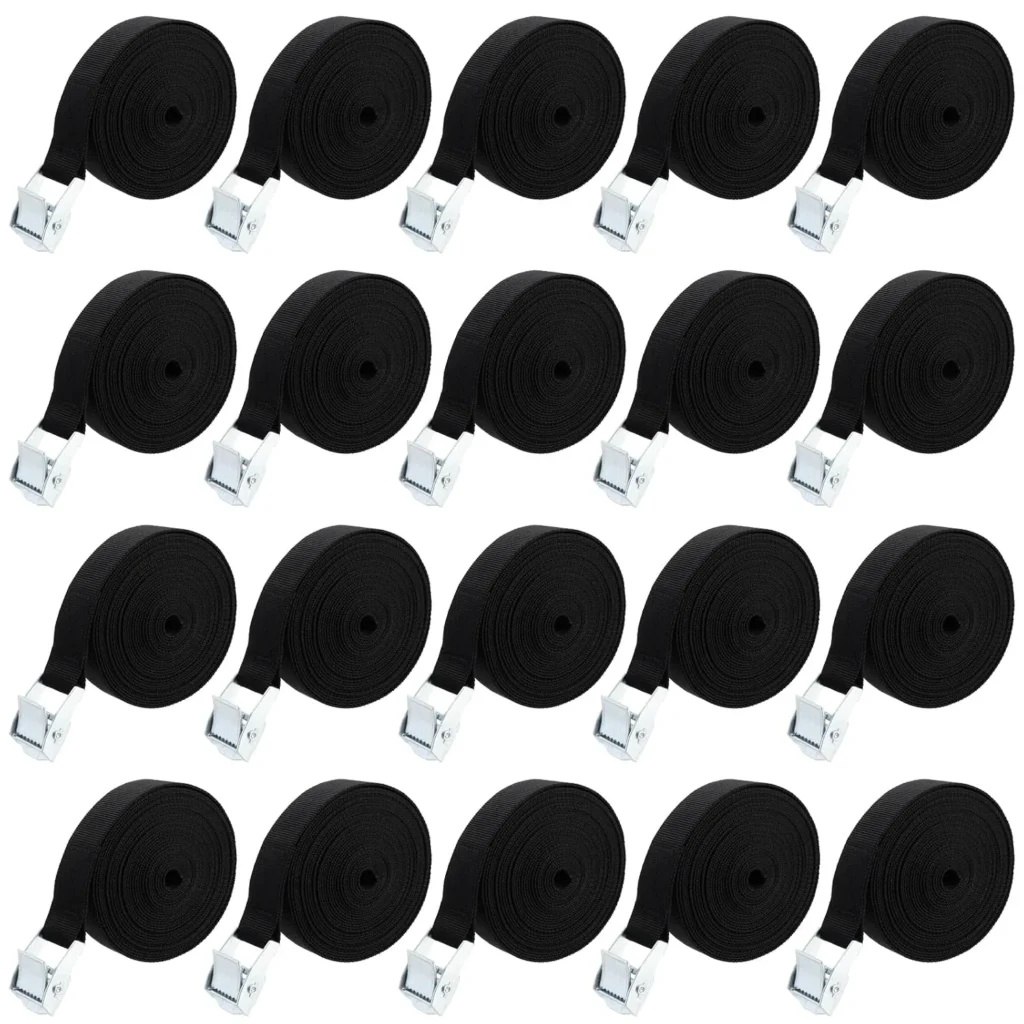
- 4 x 16ft Black Straps with Rustproof Metal Alloy Cam buckles, 1in (25mm) Wide Industrial Grade Polyester Webbing Fibers.
- 600lb BREAK STRENGTH – 300lb Working load strength – Strong enough to hold anything on your Car Roof Rack, Van or Traile…
As an Amazon Associate, we earn from qualifying purchases at no extra cost to you.
Black Friday Tip and Gift Idea
Black Friday tip: if you plan to buy roof rack straps on Black Friday 2026 (November 27) or Cyber Monday (November 30), run a piece of rope along the full strap route on your biggest load now (around the crossbars, over the load and back to the buckle), add plenty to tie off, then shortlist straps long enough for it. Check the current price on Amazon on the day rather than a “was” price.
Gift idea: a set of good cam straps is a useful stocking stuffer for anyone with a roof rack, kayak or surfboard.
FAQ
What is the best way to tie something to a roof rack?
For most loads, use cam buckle straps looped around the crossbars, not just laid over them, with at least two straps so one isn’t a single point of failure. Pull them snug enough that the load can’t shift, tie off the loose ends, then push and pull on the load to check it before you drive.
Are ratchet straps OK on a roof rack?
They can be, for hard cargo that won’t crush, but a ratchet makes it easy to pull far tighter than a load or rack needs. Tighten only until the load can’t shift. For boats and boards, cam straps are the usual choice: NRS warns that cranking straps down too hard can crack composite hulls, distort plastic boats and over-stress the rack.
Can I use bungee cords on a roof rack?
Not to hold the load. Bungees stretch, so the load can move and work loose. Use non-stretch straps for anything that matters, and keep bungees for light, non-critical jobs like holding down a tarp corner on a load that is already strapped.
Why do my roof rack straps hum or vibrate?
A flat strap in the wind can vibrate, which NRS calls strap strum. Put a twist in any section of strap that isn’t lying against the load or rack. NRS says the vibration can be strong enough to melt and part a strap, so don’t ignore it.
How many straps do I need?
At least two for most loads, one at each crossbar. NRS says even a single strap routed around both bars is still a single point of failure. Add bow and stern lines for long loads like kayaks and canoes, and follow your rack and accessory instructions.
How often should I check the straps?
Check the load before you leave, then stop after a short distance and push and pull on it again, because straps can settle and loosen. Recheck at every stop on a long trip and after rough roads or strong crosswinds.
More roof rack guides: how to remove roof racks, canoe roof racks and the quietest roof racks.

🛠️ Buying Gear for Your Work Truck?
A free Amazon Business account gets you bulk pricing, tax-exempt purchases, and business-only deals on tools, racks, and truck accessories.
Create Free Amazon Business AccountAs an Amazon Associate we earn from qualifying purchases.